Will the Japanese Yen Continue to Rise
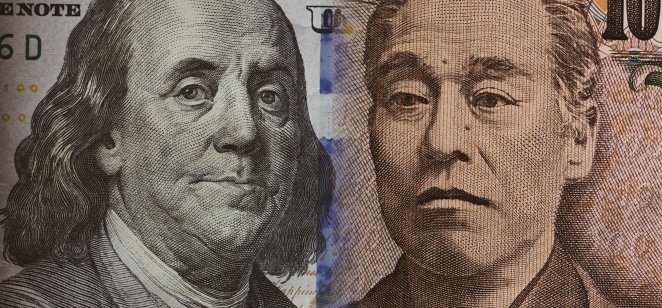
The US dollar exchange rate against the Japanese yen (USD/JPY) strengthened over the second and third quarter of 2022 as the bond yield widened amid a diverging monetary policy between the US Federal Reserve (Fed) Bank of Japan (BoJ).
The yen has recently plunged to a near 24-year low against the dollar, reaching 144.80 on 7 September.
One of the main factors driving the divergence between the dollar and the yen may be down to the fact the Fed is raising rates aggressively, while the Bank of Japan is keeping its benchmark rate at an ultra-low level. This makes the US dollar the more attractive investment option, which has largely been the case this year.
Based on his USD/JPY analysis, Fawad Razaqzada, market analyst at StoneX, told Capital.com:
"The USD/JPY has been surging higher because of the rising yield differential between the US and Japan. While the Fed is increasingly returning more hawkish, the BoJ is still pressing ahead with its existing measures to support the Japanese economy."
Economies including the US have been tightening their monetary policies this year by raising interest rates and slowing asset purchases to counter the effect of rising inflation.
The Fed raised interest rates by half a percentage point on 4 May, after its first hike in more than three years on 16 March, where the rate was lifted by 0.25%. At its last meeting in July, the Federal Reserve raised interest rates by 0.75 percentage points in an effort to rein in inflation. It also raised rates by 0.75 percentage points in June, representing at that time the largest increase at a single meeting since 1994, and expects further hikes.
Japan remains the exception. The BoJ said in May that it would continue to conduct aggressive monetary easing through yield-curve control to reduce the uncertainties in financial markets. The BoJ has set the short-term rate target at -0.25% and 0% for the 10-year Japanese Government Bond (JGB).
In contrast, the 10-year treasury yield has been rising since late 2021 and was last at 3.575%, more than doubling since the beginning of the year.
Despite the yen recovery as risk sentiment eased, Capital.com's chief market strategist, David Jones, believed that the USD/JPY trend was likely to stay firm in the near term with the ongoing inflationary pressure and interest rate hikes:
"The dollar has had an incredible run against the yen in the past couple of months, gaining by 13% to hit its best levels in 20 years. With a market that has gained so much in a short period of time it is always tempting to think that the move has been overdone – but given the ongoing threat of persistently high inflation and increased rate rises in the US, it does seem that there would be plenty of buyers for the US dollar if there was going to be any sort of sell-off. Whilst we may not see the same sort of rises again over the next two months, those hoping for a US dollar crash may have to be a little more patient."
Are you interested to learn more about the USD/JPY outlook in the near to mid term? Read this for the latest USD/JPY news and analysts' forecasts.
Bank of Japan maintains dovish policy
During the Outlook for Economic Activity speech in Japan in August, Junko Nakagawa, member of the BoJ policy board, acknowledged: "In terms of economic activity, the Bank's baseline scenario is that the economy is likely to recover toward the middle of the projection period – with the impact of the novel coronavirus (Covid-19) and supply-side constraints waning and with support from an increase in external demand, accommodative financial conditions, and the government's economic measures – although it is expected to be under downward pressure stemming from a rise in commodity prices. Also, the bank projects that a virtuous cycle from income to spending is likely to intensify gradually in the overall economy from the middle of the projection period."
The BoJ reaffirmed that it would continue with 'quantitative and qualitative monetary easing (QQE) with yield-curve control', and aims to achieve the price stability target of 2%, as long as it is necessary for maintaining that target in a stable manner.
"The year-on-year rate of increase in the CPI has been exceeding the 2 percent target level, with that for July 2022 registering 2.6 percent.
The end goal is for accommodative financial conditions to facilitate higher corporate profits and improved labor market conditions, and thereby generate a virtuous cycle in which wages and prices see sustained increases. I therefore consider it necessary to continue with monetary easing in order to realize this cycle and achieve the price stability target, accompanied by wage increases, in a sustainable and stable manner.
The BoJ also expects inflation rates to subsequently fall to a level below 2 percent as the contribution of the rise in energy prices gradually wanes. However, the underlying trend in inflation, excluding the effects of those prices, is expected to rise mildly in positive territory amid a moderate recovery in Japan's economy and improvement in the output gap.
Fed raise interest rate to counter rising inflation
Annual inflation in the US rose to a 40-year high at 8.3% in April, according to US Bureau of Labor Statistics' data released on 11 May. One of the main drivers for the accelerating rate of inflation was surging oil prices, which led to the energy index rising by 30.3% year-on-year (YoY) while the food index increased by 9.4% – the largest 12-month increase since April 1981. The annual inflation rate in August was 8.3% – down only slightly from July.
The consumer price index (CPI) has been rising every month since January 2021. The index measures what consumers pay for goods and services, including clothes, groceries, restaurant meals, recreational activities and vehicles.
Interest rate hikes and quantitative easing are tools the Fed commonly uses to control the rate of inflation. Rising inflation and interest rates are increasing the likelihood of a recession in the US, with investors pricing in the factor leading to the returns of 10-year bonds yield to fall below the 3% peak.
USD/JPY technical analysis
According to FX Street's USD/JPY technical analysis, as of 21 September, the technical tide has turned against the pair. FX Street analysts commented:
"From a technical perspective the pair looks like it is in the midst of unfolding a symetrical triangle, more clearly visible on the four hour chart, where it appears to be in the middle of forming wave D of a typical A-E five wave pattern. Triangles usually break in the direction of the broader trend, which suggests a bias to the upside. They are normally the penultimate move in a trend, suggesting the possibility that after the final breakout rally higher has peaked there is a risk the market may roll over and start a lengthier correction."
Apart from this, the broader market risk sentiment could further contribute to producing short-term trading opportunities around the major.
Dollar to Yen forecast 2022
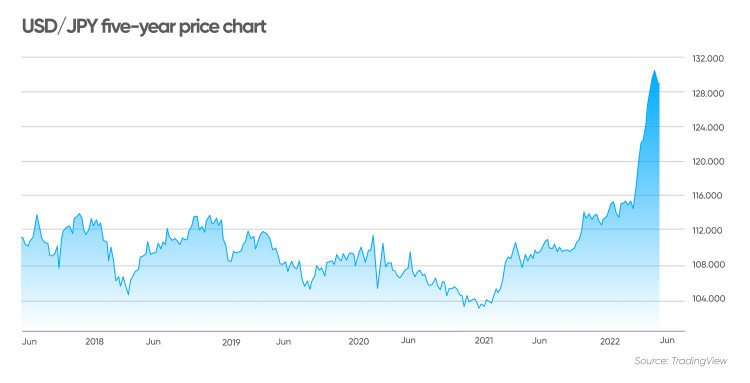
Fiona Cincotta, senior market analyst at City Index, shared a dollar/yen forecast with Capital.com:
"After a stellar rally across March and April, USD/JPY reached a 20-year high of 131.35. Whilst the price is consolidating around 129.00, bringing the RSI out of overbought territory, the pair could still have further to run. Central bank divergence has been the main driver. The Fed is expected to continue along its hawkish path, while the BoJ, in stark contrast, remains firmly dovish; one of the most dovish major central banks. This Fed-BoJ divergence is expected to be a key driving force for a few more months yet."
As of 21 September, according to AI-based forecast data provider Trading Economics, the yen was expected to trade at 144.992 against the US dollar by the end of the next quarter. JPY/USD was forecast at 151.437 in 12 months' time.
The Economy Forecast Agency predicted the Japanese yen value could depreciate against the dollar in the second half of this year. According to its USD/JPY long-term forecast, the exchange rate could rise to a high of 137.62 in December 2022. The site forecast that the exchange rate could stay mostly above 130 level in 2023 to 2026, potentially reaching a high of 150.87 in 2023.
ING predicts the Japanese yen will weaken against the US dollar, andCitibank also believes the Japanese yen will fall against the USD, but to a lesser degree. Analysts at Citibank suggest the USD/JPY pair will rising to 114 by the end of 2022.
The USD/JPY forecast 2025 and USD/JPY forecast 2030 are more difficult to obtain as macro economic factors weigh heavily on the market.
When looking at USD/JPY forex forecasts keep in mind that analysts can be wrong. Forecasts shouldn't be used as a substitute for your own research. Always conduct your own due diligence before investing. And never invest or trade money you cannot afford to lose.
FAQs
Why has USD/JPY been rising?
Currencies are traded against each other as exchange rate pairs, as the trader will need to buy or sell a currency against another. Based on the current exchange rate, $1 is equivalent to approximately JPY144. The exchange rate over the past year indicates that the Japanese yen is weakening against the US dollar.
Will USD/JPY go up or down?
According to Trading Economics, the Japanese yen is expected to trade at 144.99 by the end of this quarter, according to global macro models and analysts expectations. Whether or not it is a suitable investment for you depends on your personal circumstances and risk tolerance, among other factors. Keep in mind that past performance is no guarantee of future returns. nd enver invest money that you cannot afford to lose.
What is the best time to trade USD/JPY?
The ideal time to trade USD/JPY is generally at between 12:00 to 15:00 Greenwich Mean Time (GMT), when market activity is at its highest level.
Why has the USD/JPY rate been going up?
The dollar against yen rate has been going up because of the widening differentials in the interest rates between the US and Japan. The US dollar has strengthened on a higher interest rate while yen weakened on the negative interest rate. The Federal Reserve raised its interest rate to 0.75-1%, in May, and is currently facing another historic 1% hike, while the Bank of Japan maintained a -0.1% interest rate.
campbellphroodession.blogspot.com
Source: https://capital.com/usd-to-jpy-forecast
0 Response to "Will the Japanese Yen Continue to Rise"
Post a Comment